
Projet innovation
Test itératif assure l'innovation
A construction site in Shanghai can host 300–2,000 workers from various regions. To comply with Shanghai's real-name registration system for construction workers, site supervisors must verify each morning that workers' IDs match the government database. The client's project involves developing head-mounted augmented reality (AR) glasses to help supervisors quickly identify workers on-site and ensure they are in the correct location at all times.
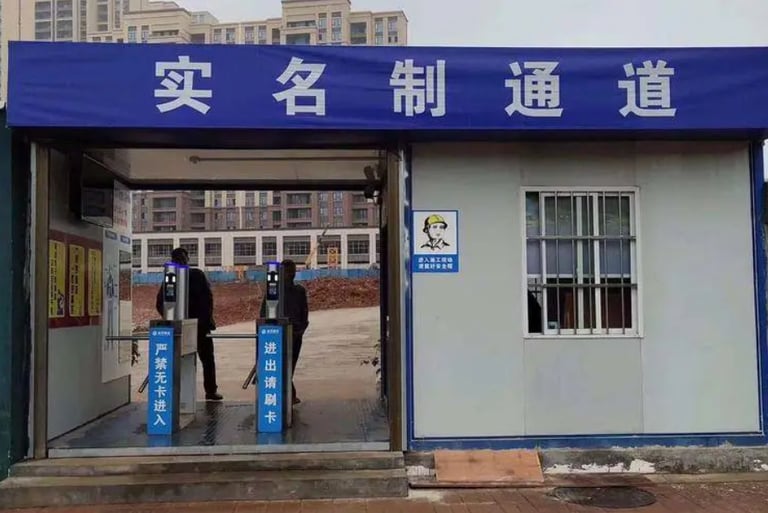
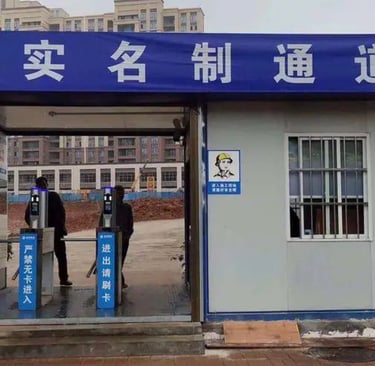
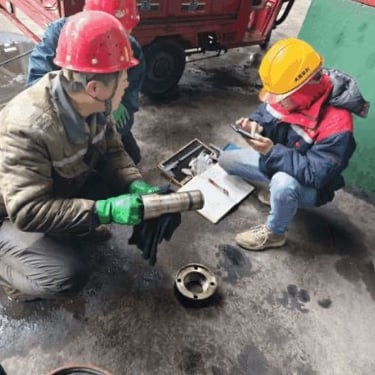
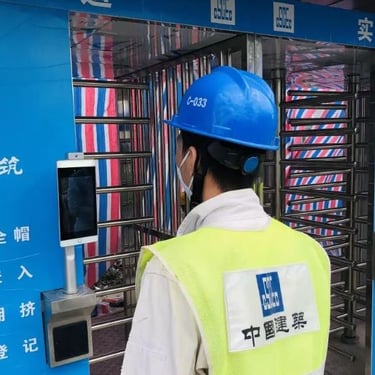
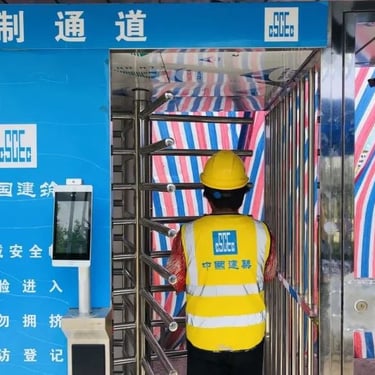
The data base compares the IDU and face recognization data with the work laborer to give permission to get into the construction site
Photo from google.com
Project Overview
Timeline
Exploration Phase: 2 weeks (User Interviews)
Iterative Design Phase: 14 weeks (Prototyping & Testing)
Total Project Duration: 9 months
Team
1 Developer
1 Admin & Cloud Engineer
1 UX Researcher
Project Scope
An innovative Industrial AR glasses system designed for construction sites, featuring:
Face recognition for legal ID verification
Real-time database comparison to grant site access (Due to confidentiality, sensitive company and product details are omitted.)
Database Workflow The system compares ID verification data (e.g., government-issued IDs) with worker records in the database to grant/deny site access.
Construction Site Context (Shanghai)
A construction site in Shanghai can host 300–2,000 workers from diverse regions. To comply with local regulations, supervisors must verify each morning that:
Workers’ IDs match local government records
Their legal working status is confirmed
The client’s head-mounted AR glasses assist supervisors by:
Quickly identifying workers on-site
Ensuring they are in the correct location at the right time
My Role & Research Process
Role:
Design and lead the research project involving stakeholders
Recruit and organize iterative tests
Collect and analyse feedback and data, turning them into actionable recommendations
Research Goal:
Understand target users in his/her working environment
Improve continuously the usability of design with the feedback
Methodology
Initial Interviews (Exploration Phase)
Conducted semi-structured interviews to uncover different user pain points:
"Describe a typical workday."
"How often do you verify workers’ IDs? Walk me through the process."
"What are the possible outcomes of an inspection?"
"How would you describe your inspection tasks?"
Personas
Created 4 user personas based on interviews/surveys to:
Align the team with user goals/behaviors
Challenge assumptions during design iterations
Updated iteratively as new data emerged.
Usability Testing
Conducted systematic evaluations of the AR glasses throughout development.
Key Finding: Many usability issues aligned with common-sense expectations—proving the value of real-world testing over assumptions.
Core Functionality Tested
Supervisors use the glasses to:
Scan a worker’s face
Wait for database verification
Receive real-time feedback on their legal status:
"Not registered in local records"
"Not government-approved"
"Fully compliant"
Result
Issue 01: Visibility (Light Adaptation Challenges)
Problem Description: The AR glasses face significant light adaptation challenges in construction site environments, severely limiting both camera recognition and screen display functionality:
Low-light environments (e.g., underground construction, night shifts):
Insufficient camera exposure prevents clear facial image capture
Facial recognition accuracy drops by 30-50% (based on internal testing)
Workers must use additional lighting (e.g., flashlights) to complete verification
High-light environments (e.g., outdoor sites, reflective surfaces):
Screen content (e.g., "Registered/Not Registered" results) becomes unreadable due to glare
Users must repeatedly adjust viewing angles, increasing verification time
Display contrast remains fixed, failing to adapt to extreme lighting conditions
Root Causes:
Lack of automatic brightness adjustment in the lens design
Fixed-contrast display unable to handle dynamic lighting conditions
No environmental light sensors to trigger adaptive responses
Recommended Solutions:
Hardware Improvements:
Integrate ambient light sensors for real-time exposure and brightness adjustment
Upgrade to OLED self-luminous displays to maintain high contrast in low-light conditions
Apply anti-glare coatings to reduce reflections in bright environments
Implement infrared cameras for enhanced low-light facial recognition
Software Enhancements:
Develop adaptive UI that automatically adjusts font size and contrast based on lighting
Create offline mode for stable verification in unstable network environments
Implement dynamic brightness compensation algorithms
Issue 02: Adjustment of Glasses Sizes
Problem Description: The current single-size design fails to accommodate 20-30% of workers, causing discomfort and verification inaccuracies:
Nose bridge issues: Too narrow for some users, causing glasses to slip; too wide for others, creating pressure points
Temple arm discomfort: Fixed length causes headaches after prolonged use (2+ hours)
Field of view obstruction: Oversized frames limit peripheral vision, affecting safety
Root Causes:
Insufficient consideration of ergonomic diversity during design phase
Lack of adjustable components (e.g., extendable nose pads, rotatable temple arms)
Limited testing with diverse user groups (age, gender, facial structure)
Recommended Solutions:
Design Improvements:
Implement modular frame system with S/M/L size options
Add adjustable nose pads (±5mm range) for personalized fit
Use flexible silicone temple arms to accommodate different head shapes
Issue 03: Identification Difficulties (Environmental and Technical Limitations)
Problem Description: Construction sites present multiple identification challenges that degrade system performance:
Dusty environments :
Facial features become obscured by cement dust, dirt, and sweat
Facial recognition accuracy drops by 40% (field testing results)
Workers must clean faces repeatedly, adding 10+ seconds per verification
Single-person recognition limitation:
Camera can only identify one person at a time
In crowded areas (e.g., cafeterias, changing rooms), verification becomes a bottleneck
Group verification requires 50-100% more time than single-person scenarios
Root Causes:
Camera hardware: Standard modules lack dust protection (IP54 rating insufficient)
Network constraints: Cloud-based verification fails in unstable connectivity areas
Recommended Solutions:
Hardware Upgrades:
Integrate infrared sensors for facial recognition through dust/obstructions
Equip with high-performance processors for multi-person detection